
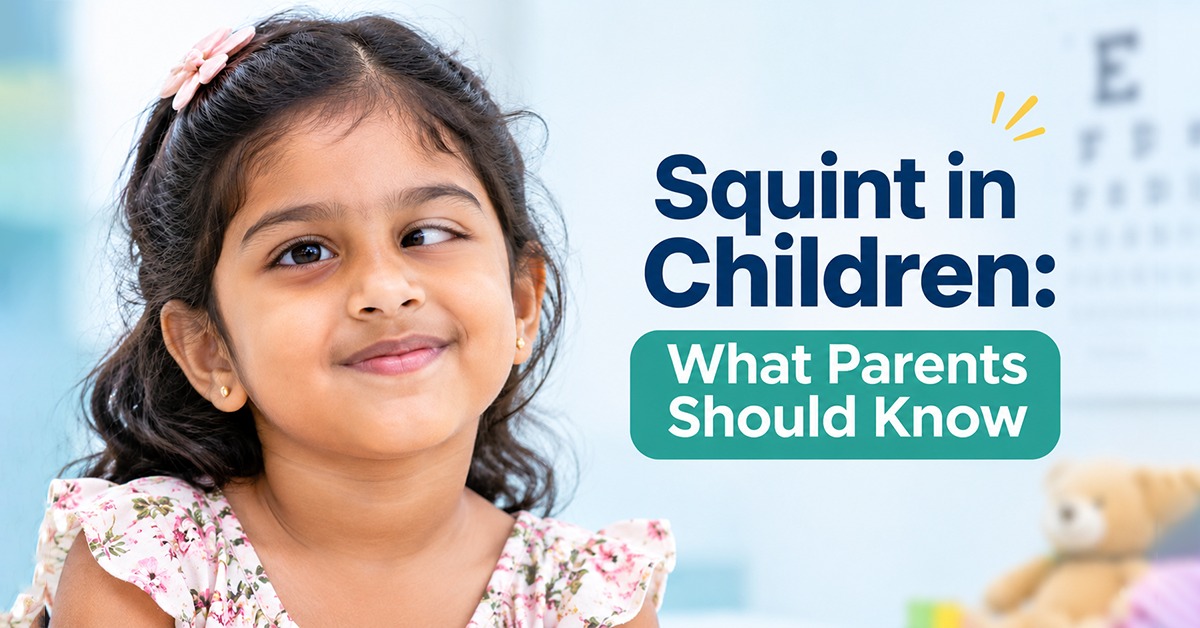
You might have noticed one of your child's eyes turning inwards when
looking at you. Or perhaps it turns outwards when your child is tired. It may
happen quite often, or just once in a while. Some parents first spot it in
photographs and then start watching their child's eyes more closely.
Naturally, questions come up. Is it really a squint? Will it go away as
the child grows? Could it affect eyesight?
A squint (strabismus) is when both eyes don't look in the same
direction. One eye may turn inwards, outwards, upwards, or downwards. And it
doesn't have to happen all the time. A child may have perfectly
straight-looking eyes most of the day, but one eye may turn occasionally. This
is called an intermittent squint.
Some children look cross-eyed but don't actually have a squint. It's
called a pseudo-squint. A broad, flat nose bridge or extra skin folds near the
inner corners of the eyes can sometimes give this impression. The eyes are
actually aligned. It can be difficult to tell just by looking, so an eye check
is the best way to know.
Parents usually notice the eye turning in or out first. But there
may be other little things going on as well. Your child might turn their head
to watch TV, keep one eye closed when playing outside or find ball games a bit
difficult. Maybe they don't seem to judge distances very well, either, or have trouble
keeping their eyes on something moving.
Headaches, blurred vision and tired eyes are worth looking out for, too. And sometimes you'll reach the doctor's
office only to find that both eyes look perfectly normal! That doesn't mean
there is nothing wrong. A squint can come and go. If you have a photo or video
of it happening at home, take it along to the appointment.
Both eyes are supposed to work together. They send pictures to the
brain, which combines them into one clear view of the world.
When one eye turns, the pictures may not line up. The brain can start
ignoring the image from that eye to avoid double vision. If this happens while
the child's vision is still developing, that eye may become weaker. This is
called lazy eye, or amblyopia.
And children don't always know this is happening. They may read, play,
and do their usual activities using the stronger eye. Nothing may seem wrong to
them, and they probably won't tell you that one eye is seeing less clearly.
That's why the doctor checks each eye separately. Even when a child seems to
see perfectly well with both eyes open, one eye may still need attention.
The doctor needs to assess the child's vision, eye alignment, eye
movements, and ability to focus. Long-sightedness and other refractive errors
are also checked, as they can sometimes contribute to a squint.
Some children may improve with glasses alone. Others need patching,
where the stronger eye is covered for a prescribed number of hours to
encourage the weaker eye to work. Atropine drops are another option in
selected cases. These are put into the stronger eye to temporarily blur its
vision, encouraging the child to use the weaker one.
Orthoptic treatment may also help with certain eye movement and
coordination problems. Depending on the condition, this may involve exercises
or prism lenses. It is not suitable for every kind of squint.
Then some children need surgery. Squint surgery helps bring the
eyes into better alignment by adjusting the eye muscles. But it doesn't
automatically correct lazy eye. Some children may still need glasses or
patching afterward, so follow-up visits and continuing treatment matter. Don't
stop just because the eyes look straight.
Dr. Tony Fernandez Eye Hospital, Aluva, has a Pediatric Ophthalmology
and Squint Services department. The Orthoptic Department also looks after eye
movement and alignment problems. For some children with lazy eye, we may
consider patching and options such as Orthoptek™.
Children do not always know when their vision is not developing
properly. They learn to manage with what they can see. So, if something about
your child's eye movements bothers you, even if you cannot quite explain it,
get it checked. It is better to find out that there is no problem than to miss
one during the years when vision is still developing.